More about the Spectrum
A new way of seeing organisations
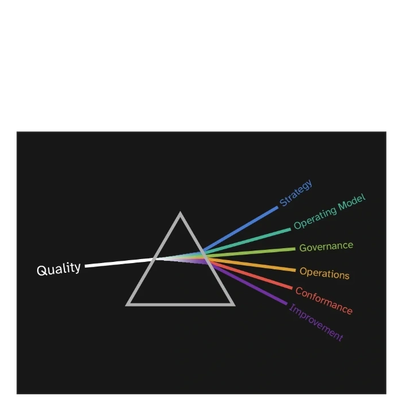
The Quality Spectrum is a framework, or meta-model, for understanding quality as a system property rather than a function, a role, or a set of tools. It maps the full range of quality activity across six domains — each with a distinct purpose, each shaping the others — and shows how the behaviour of an organisation emerges from the interactions between them.
The central insight is simple but consequential: quality is not something an organisation does in one place, it's what the organisation does when its domains are aligned. When they are, organisations perform consistently, innovate responsibly, and adapt sustainably. When they aren't, no amount of process, audit, or improvement activity will compensate.
Like light passing through a prism, the Spectrum doesn't create something new — it reveals what was always present but rarely visible as a whole.
The six domains
Strategy sets the intent and direction of the organisation — the purpose, values, and choices that everything else must express. Without clarity here, no other domain can function coherently.
Operating Model translates strategy into the design of how work actually happens — roles, processes, structures, and the relationships between them. It is the architecture of the organisation in practice.
Governance provides the rules, controls, decision rights, and ethical boundaries that shape behaviour across the system. Strong governance enables responsible innovation and confident decision-making. Weak governance makes the system unpredictable.
Operations is where strategy meets reality — where work is done, value is created, and the system reveals its true behaviour. It is where quality is experienced.
Conformance is the evidence domain — the systematic understanding of what the system actually did, how it performed, and what it reveals about underlying conditions. Without trustworthy evidence, improvement becomes guesswork.
Improvement closes the loop — turning evidence into learning, learning into change, and change into capability. It is how the system evolves over time.
How the domains interact
The domains are not a checklist or a maturity model. They are an interconnected system. A change in one domain creates consequences in others. A strategic shift affects design and governance. A governance change affects operations and evidence. Operational pressures affect improvement. Improvement insights should reshape strategy.
This is why quality cannot be managed from a single vantage point. It requires the ability to read the whole system — to see how intent becomes design, how design becomes behaviour, how behaviour becomes evidence, and how evidence becomes learning.
A framework above frameworks
The Quality Spectrum is not the advocate of any particular standard or methodology, although it could be forgiven for being evangelistic about systems thinking and integrative approaches. ISO 9001, ISO 31000, ITIL, TOGAF, CMMI, Hoshin Kanri — these and many others each address important aspects of organisational performance. The Spectrum does not replace them. It reveals the system that all of them are trying to serve, providing the common language that connects their contributions without giving any one approach privilege. This is particularly important in organisations where multiple standards and frameworks co-exist, and where the risk of methodological fragmentation is as real as the risk of quality fragmentation.
The Quality Integrator
The Spectrum gives rise to a new practitioner identity: the Quality Integrator. This is not a replacement for specialist expertise — it complements it. The Integrator works across domains, connects what others keep separate, interprets system behaviour for leaders, and positions quality as a driver of organisational capability rather than a check on its outputs.
In a world where artificial intelligence is reshaping every domain of organisational life, the integrative capability the Spectrum describes has never been more relevant — or more urgently needed.
Where to go next
If you are new to the Spectrum, The Quality Spectrum: The System Lens for Quality, Innovation, and Capability is the place to start. The book develops each domain in depth, introduces the Quality Integrator identity, and makes the case for why quality and innovation are two expressions of the same systemic capability.
The Quality Spectrum Guides — a series of domain-specific practical volumes currently in development — will provide deeper guidance for each domain in turn. Watch this space!